
Indonesia · Music licensing guide
Background Music Licensing in Indonesia: The Essential Guide for Businesses
To play music in an Indonesian business, six rights must be cleared: public performance of the composition, public performance of the sound recording, reproduction of the sound recording, recording and master rights, publishing rights for commercial use, and the performers’ right to be paid. Consumer apps like Spotify cover none of them. Using music without permission or payment is taking someone else’s work without paying for it.
Using music without permission or payment is theft. Simple. Every song has owners and performers who are entitled to permission, payment, or both. This guide explains the six rights an Indonesian business must clear, how Indonesia enforces them today, and the simplest way to hold all of them to the international standard.
Who needs a music licence in Indonesia?
Any business where music can be heard by customers, guests or staff. That includes:
Background music for hotels
Lobbies, restaurants, spas and guest areas.
Background music for restaurants
Fine dining to casual dining and franchises.
Background music for cafés
Independent cafés and coffee chains.
Background music for shopping centres
Common areas, atriums and tenant stores.
Background music for offices
Receptions, workspaces and staff areas.
Background music in Jakarta
Venues across the capital and Greater Jakarta.
Background music in Bali
Resorts, beach clubs, restaurants and villas.
Background music in Surabaya
Hotels, malls and F&B in East Java.
Is music licensing enforced in Indonesia?
Yes. Collection is being enforced, and in 2025 non-payment became a criminal matter for the first time.
In July 2025, Bali Police named the director of PT Mitra Bali Sukses, the operator of Mie Gacoan restaurants in Bali, a criminal suspect for playing music in its outlets without paying royalties since 2022. The case followed a report by SELMI, a collective management organisation representing performers, and was brought under Article 117 of Indonesia’s 2014 Copyright Law. LMKN said it was the first time anyone had faced criminal charges for failing to pay music royalties.
The case ended in a settlement in August 2025: the company paid Rp2.2 billion in royalties to SELMI and the suspect status was lifted. The bill had been building at the published restaurant rate of around Rp120,000 per seat per year.
What the law allows, as reported by The Jakarta Post
Under Permenkum 27/2025, the obligation to pay sits with the business owner or event organiser, not the performer, the installer or the music app. See also music licensing in Jakarta, Bali and Surabaya.
What’s inside a song?
A song feels like one thing, but it is made of three parts, and each part can belong to someone different.
Think of a song like a birthday cake.
Many people can bake a cake from the same recipe, just as one song can be recorded by many artists. Each recording has its own owner, but the recipe still belongs to whoever wrote it.
To share the cake with your customers, you need a yes from everyone who owns a part of it. If you also make a copy of the cake to keep, by downloading the song or storing it on a device, that copy needs its own yes. One yes is never enough. And in Indonesia, the singers and musicians who performed on the recording are also entitled to be paid each time it is played in public.
What licences does a business need to play music in Indonesia?
Commercial background music engages six rights, and all six must be cleared. Rights 1 to 5 belong to songwriters, publishers and record labels. Right 6 belongs to the singers and musicians on the recording, who are entitled to be paid.
- 1
Public performance of the composition
Playing the song itself, the melody and lyrics, where customers or staff can hear it.
Owned by songwriters, composers and publishers - 2
Public performance of the sound recording
Playing that specific recorded track: the version your customers actually hear.
Owned by record labels and recording owners - 3
Reproduction of the sound recording
Copying the recording: downloading it, caching it in an app, ripping it from a CD or storing it on a USB or media player. Nearly every music system copies files to play them reliably, and a copy made without the owner’s permission is an infringement in its own right.
Owned by record labels and recording owners - 4
Recording and master rights
Your music supplier must own or hold rights in the master recordings it supplies for commercial use. Without them, the music is pirated.
Held by your music supplier - 5
Publishing rights for commercial use
Your music supplier must also hold the rights in the compositions it supplies. These explain why permission is needed at all, wherever the music file comes from.
Held by your music supplier - 6
Performers’ right to be paid
The singers and musicians who performed on a recording are entitled to be paid whenever it is used commercially. In Indonesia this is collected centrally by LMKN and passed to the collective management organisations that represent performers.
Paid to singers and musicians
Music licensing in Indonesia, simplified
One song has several owners and performers. Every one must give permission or be paid.
What is your business doing with the music?
Each use needs permission, payment, or both.
Who made the music?
Your music supplier must hold rights ④ and ⑤, and the performers must be paid ⑥. Without them, the music is pirated or unpaid.
Six requirements. Miss one, and you’re not licensed.
Five need permission. One needs payment. All six are required.
Local rules and the international standard
Indonesia is still aligning with global copyright practice. MUSICVYBE licenses to the international standard, not the local minimum.
Indonesian copyright law lets a business use songs commercially without asking the owners first, provided it pays royalties through the collective system. LMKN collects those royalties centrally and distributes them to the collective management organisations (LMK) for songwriters, performers and record producers.
That is the local minimum, and it only covers public performance. It does not license the copying of recordings onto devices, and it does not give a music supplier any right to sell the music it plays. Under the international copyright treaties, owners have the right to grant or refuse permission. Using their music without permission or payment is theft of their work.
The direction of travel is clear. Twenty years ago China was regarded as the world’s capital of copyright infringement. Today its courts hear cases brought by global brands, and Chinese authorities prosecute local companies for infringing international copyright. Markets that align with global practice do not loosen enforcement; they tighten it.
MUSICVYBE holds direct licences from rights owners for every track it supplies, so all six rights are cleared with the owners’ permission and payment, wherever the local rules are today.
Can a business use Spotify, YouTube or Apple Music in Indonesia?
No. Consumer streaming services are licensed for personal listening only, and their own terms say so.
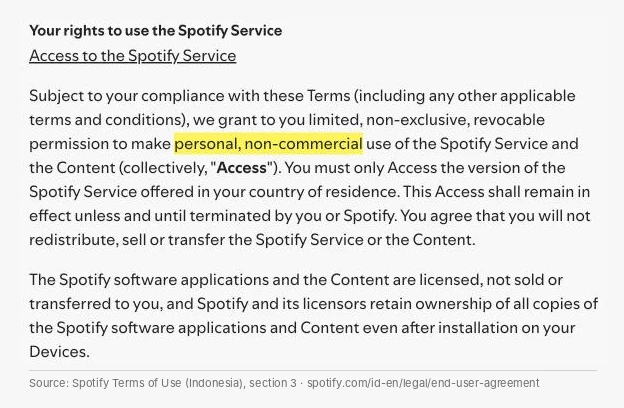
Playing a personal subscription in a shop, café, hotel or office falls outside that permission, and it covers none of the six rights above. The same applies to YouTube, Apple Music, Joox, Resso, Amazon Music, TIDAL, CDs and downloaded files.
Read the platform-by-platform answers: Spotify, YouTube, Apple Music, Amazon Music and TIDAL.
Is royalty-free music a safe option?
Royalty-free does not mean free, and it does not mean you own the music. Usually a one-off fee buys a limited set of permissions defined by the seller’s licence. Many libraries license tracks for videos and online content, not for public performance in commercial premises.
Verdict: royalty-free music is only safe if its licence names every use your business makes of it, including public performance in a commercial venue in Indonesia. If it doesn’t, you still need the missing rights. More on royalty-free music for commercial use in Indonesia.
Why the collective route leaves gaps
Paying LMKN clears at most three of the six rights, and only to the local minimum.
LMKN collects for public performance of the composition and the sound recording, and for the performers’ share. It does not license reproduction of recordings onto devices, and no collective body in Indonesia licenses master or publishing rights for commercial use. Paying LMKN also supplies no music, so the source still has to be licensed.
| Licensing it yourself | MUSICVYBE | |
|---|---|---|
| Rights covered | At most 3 of 6, through LMKN | All 6 |
| Standard | Local minimum: payment for public performance | International: permission and payment for every right |
| Reproduction of the sound recording | Not covered by the collective system | Included for every track |
| Music source | Often consumer apps or downloads, licensed for personal use only | Directly licensed commercial catalogue |
| Curation | Do it yourself | Curated playlists by venue and time of day |
MUSICVYBE: all six rights in one licence
MUSICVYBE is a fully licensed background music service for Indonesian businesses. Its catalogue is licensed directly from rights owners, so every right is cleared before the music reaches your venue.
- All six rights for every track, including the performers’ share
- Our position is that no LMKN or LMK licence is required for the music MUSICVYBE delivers, because the catalogue sits outside LMKN and LMK repertoire
- Curated playlists by venue type and time of day, updated monthly and seasonally
- Centralised control across one venue or many locations, with monitoring and technical support
Trusted across Asia by Fairmont and Swissotel Singapore, OCBC Bank Malaysia, Nu Sentral and Parkroyal Penang. See the case studies.
Who collects what in Indonesia
In Indonesia, LMKN collects royalties centrally for public performance and passes them to the LMK for songwriters, record producers and performers. No collective body covers reproduction, master or publishing rights.
| Right | Collected or held by | Under local rules | MUSICVYBE |
|---|---|---|---|
| 1. Public performance of the composition | LMKN, for songwriters’ LMK | Payment, no prior permission | Yes |
| 2. Public performance of the sound recording | LMKN, for record producers’ LMK | Payment, no prior permission | Yes |
| 3. Reproduction of the sound recording | Recording owners directly | Permission required | Yes |
| 4. Recording and master rights | Record labels, held by your supplier | Permission required | Yes |
| 5. Publishing rights for commercial use | Publishers, held by your supplier | Permission required | Yes |
| 6. Performers’ right to be paid | LMKN, for performers’ LMK such as SELMI | Payment | Yes |
For the regulation behind this, read Permenkum 27/2025 explained and the Indonesia music licensing overview. Running venues elsewhere in Asia? See the Singapore and Malaysia licensing guides.
Frequently Asked Questions
Do I need a licence to play background music in my Indonesian business?+
Yes. If music can be heard by customers, guests or staff in a commercial space, six rights are involved: public performance of the composition and of the sound recording, reproduction of the sound recording, the recording and publishing rights your music supplier must hold, and the performers’ right to be paid.
Is paying LMKN enough?+
No. LMKN collects for public performance and the performers’ share: at most three of the six rights. It does not license copying music onto devices, and it does not cover the master or publishing rights a music supplier needs.
Can I play Spotify in my restaurant, café or office in Indonesia?+
No. Spotify’s Indonesian terms grant personal, non-commercial use only, and the same applies to YouTube, Apple Music, Joox and other consumer apps. See Can I use Spotify in my business?
What happened in the Mie Gacoan case?+
In July 2025 Bali Police named the director of the company operating Mie Gacoan restaurants in Bali a suspect for playing music without paying royalties since 2022, after a report by SELMI. The case settled in August 2025 with Rp2.2 billion paid to SELMI.
Who has to pay, the business or the music supplier?+
Under Permenkum 27/2025 the obligation sits with the business owner or event organiser. A supplier’s contract does not move that responsibility unless the supplier holds direct licences for the music it delivers.
Do I still need LMKN or LMK licences if I use MUSICVYBE?+
Our position is that no collective licence is required for the music MUSICVYBE delivers, because the catalogue is directly licensed and sits outside LMKN and LMK repertoire. Music from other sources, such as live bands, is assessed on its own terms.
Does music played only to staff need a licence?+
Yes. A workplace is a commercial space, so music played to employees is commercial use, not private listening.
Sources
- The Jakarta Post, Mie Gacoan Bali franchise operator named suspect for failing to pay music royalties (July 2025): www.thejakartapost.com
- Metro TV, Mie Gacoan pays Rp2.2 billion in royalties to SELMI: www.metrotvnews.com
- Rajah & Tann, Regulatory update: royalty management in Indonesia’s music industry: www.rajahtannasia.com
- Spotify Terms of Use (Indonesia): www.spotify.com
This guide explains general principles and is not legal advice.
Find out which rights your business is missing
Book a free, no-obligation licensing review for your Indonesian venue.
Related Pages
| Music Licensing in Indonesia | Overview of LMKN and the collective system |
| Permenkum 27/2025 Explained | What the 2025 regulation means for venues |
| Background Music in Indonesia | MUSICVYBE’s service for Indonesian businesses |
| Music Licensing for Business | Cross-market guide to licensing background music |