
Singapore · Music licensing guide
Background Music Licensing in Singapore: The Essential Guide for Businesses
To play music in a Singapore business, you need permission for five rights: public performance of the composition, public performance of the sound recording, reproduction of the sound recording, recording and master rights, and publishing rights for commercial use. Consumer apps like Spotify grant none of them. Miss one, and your business is not licensed.
Copyright law is simple: you either have permission, or you don’t. Where the music comes from, what you paid for it and which app plays it do not change that. This guide explains which permissions a Singapore business needs, how enforcement works, and the simplest way to hold all of them.
Who needs a music licence in Singapore?
Any business where music can be heard by customers, guests or staff. That includes:
Background music for hotels
Lobbies, lifts, restaurants, spas and guest areas.
Background music for retail stores
Single shops, chains and pop-ups.
Background music for shopping malls
Common areas, atriums and car parks.
Background music for restaurants
Fine dining to casual dining.
Background music for cafés
Independent cafés and coffee chains.
Background music for bars and nightclubs
Where enforcement has already reached the courts.
Background music for gyms
Workout floors, classes and changing rooms.
Background music for spas and salons
Treatment rooms and reception areas.
Background music for offices
Receptions, workspaces and waiting rooms.
Is music licensing enforced in Singapore?
Yes, including through criminal prosecution.
In COMPASS v Slim Entertainment, the operator of Catwalk KTV Lounge at Textile Centre on Jalan Sultan was convicted in October 2025 on 20 charges for performing ten songs in public without a licence. There was one charge for each composition and one for each set of lyrics. Licensing executives had booked a private room as ordinary customers, sung the songs and recorded the session as evidence, after the company failed to respond to repeated letters.
On 22 January 2026 the company was fined S$20,000. The judge said it had shown “a blatant disregard for the law”. A separate prosecution was brought against the company’s director.
What the law allows, as reported by CNA
These penalties apply to the offence of causing copyright works to be performed in public for profit without permission. Copyright owners can also bring civil claims for damages, injunctions and legal costs. Under the Copyright Act 2021, responsibility sits with the business operating the premises, not with the app or device playing the music. Bars, nightclubs and KTV venues face the closest scrutiny: see background music for bars and nightclubs.
What’s inside a song?
A song feels like one thing, but it is made of three parts, and each part can belong to someone different.
Think of a song like a birthday cake.
Many people can bake a cake from the same recipe, just as one song can be recorded by many artists. Each recording has its own owner, but the recipe still belongs to whoever wrote it.
To share the cake with your customers, you need a yes from everyone who owns a part of it. If you also make a copy of the cake to keep, by downloading the song or storing it on a device, that copy needs its own yes. One yes is never enough. The Catwalk case proves the point: ten songs produced twenty charges, because the law counted each tune and each set of lyrics separately.
What licences does a business need to play music in Singapore?
Commercial background music engages five distinct rights. The first three cover what your business does with the music. The last two cover where the music comes from.
- 1
Public performance of the composition
Permission to play the song itself, the melody and lyrics, where customers or staff can hear it. More on public performance licences in Singapore.
Owned by songwriters, composers and publishers - 2
Public performance of the sound recording
Permission to play that specific recorded track: the version your customers actually hear.
Owned by record labels and recording owners - 3
Reproduction of the sound recording
Permission to copy the recording: downloading it, caching it in an app, ripping it from a CD or storing it on a USB or media player. Nearly every music system copies files to play them reliably. A copy made without the owner’s permission is an infringement in its own right. See how the reproduction licence works.
Owned by record labels and recording owners - 4
Recording and master rights
Your music supplier must own or hold rights in the master recordings it supplies for commercial use. Without them, the music is pirated.
Held by your music supplier - 5
Publishing rights for commercial use
Your music supplier must also hold the rights in the compositions it supplies. These explain why permission is needed at all, wherever the music file comes from.
Held by your music supplier
Music licensing in Singapore, simplified
One song has several owners. Every use needs their permission.
What is your business doing with the music?
Each use needs its own permission.
Where does the music come from?
Your music supplier must hold these rights from the owners. Without them, the music is pirated.
Five permissions. Miss one, and you don’t have permission.
Copyright law is simple: you either have permission, or you don’t.
Can a business use Spotify, YouTube or Apple Music?
No. Consumer streaming services are licensed for personal listening only, and their own terms say so.
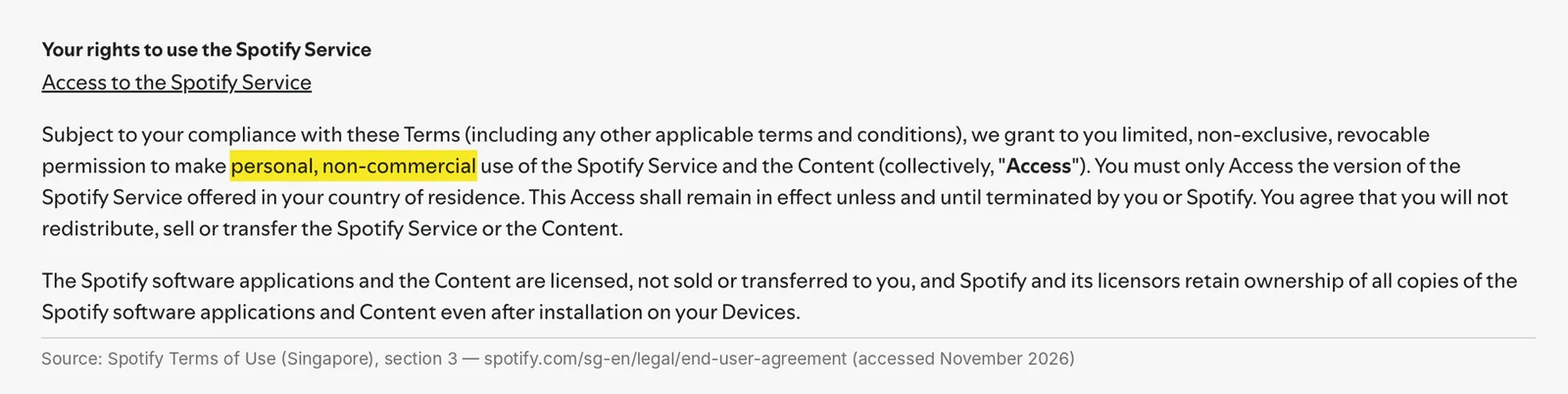
Playing a personal subscription in a shop, café, hotel or office falls outside that permission. It also covers none of the five rights above: the app’s licence is between the platform and the rights owners, for private listening. The same applies to YouTube, Apple Music, Amazon Music, TIDAL, CDs and downloaded files.
Read the platform-by-platform answers: Spotify, YouTube, Apple Music, Amazon Music and TIDAL, or see using Spotify in a Singapore business.
Is royalty-free music a safe option?
Royalty-free does not mean free, and it does not mean you own the music. Usually a one-off fee buys a limited set of permissions defined by the seller’s licence. Reproduction may be included. Public performance often is not, particularly where the composer belongs to a collecting society.
Verdict: royalty-free music is only safe if its licence names every use your business makes of it, including public performance in a commercial venue in Singapore. If it doesn’t, you still need the missing permissions. More on royalty-free music in Singapore.
Why the traditional route leaves gaps
Businesses that license music themselves hold, at best, three of the five rights, and often believe they hold all of them.
COMPASS licenses performance of the composition. MRSS licenses performance of the sound recording and, under a separate per-device licence, its reproduction; a business that skips that licence while playing downloaded or stored files is still infringing. No collecting society in Singapore licenses master or publishing rights for commercial use, and neither society supplies the music, so the source must be licensed separately. And a blanket licence only covers the society’s own repertoire: in COMPASS v Golden Village Multiplex [2021] SGHC 2, the High Court confirmed that a licence for works in a society’s repertoire is not a licence for all music.
| Licensing it yourself | MUSICVYBE | |
|---|---|---|
| Rights covered | At most 3 of 5 | All 5 |
| Reproduction of the sound recording | A separate MRSS licence for every playback device | Included |
| Music source | Often consumer apps or downloads, licensed for personal use only | Directly licensed commercial catalogue |
| Agreements to manage | Several, each with its own renewal | One subscription |
| Repertoire gaps | Possible: blanket licences cover member works only | None: every track is cleared at source |
| Curation | Do it yourself | Curated playlists by venue and time of day |
MUSICVYBE: all five rights in one licence
MUSICVYBE is a fully licensed background music service for Singapore businesses. Its catalogue is licensed directly from rights owners, so every right is cleared before the music reaches your venue.
- All five commercial music rights for every track
- Curated playlists by venue type and time of day, updated monthly and seasonally
- Centralised control across one venue or many locations
- Monitoring and technical support
- One agreement that covers every track you play
saved every year by Swissotel The Stamford Singapore after replacing separate collecting society fees, streaming subscriptions and ad hoc music arrangements with one MUSICVYBE subscription. Read the Fairmont and Swissotel case study.
Who licenses what in Singapore
Two collective management organisations license music use in Singapore. COMPASS covers one of the five rights; MRSS covers two, through separate licences. Neither licenses master or publishing rights.
| Right | Administered by | COMPASS licence | MRSS licence | MUSICVYBE |
|---|---|---|---|---|
| 1. Public performance of the composition | COMPASS | Yes | No | Yes |
| 2. Public performance of the sound recording | MRSS | No | Yes | Yes |
| 3. Reproduction of the sound recording | MRSS, separate licence | No | Yes, per device | Yes |
| 4. Recording and master rights | Record labels, held by your supplier | No | No | Yes |
| 5. Publishing rights for commercial use | Publishers, held by your supplier | No | No | Yes |
For the law behind these rights, see the Singapore Copyright Act 2021 and music licensing laws in Singapore. Running venues elsewhere in Asia? See the Malaysia, Indonesia and Vietnam background music licensing guides.
Frequently Asked Questions
Do I need a licence to play background music in my Singapore business?+
Yes. If music can be heard by customers, guests or staff in a commercial space, you need permission for every right that use engages. For most businesses that means five rights: public performance of the composition and of the sound recording, reproduction of the sound recording, and the recording and publishing rights your music supplier must hold.
Can I play Spotify in my shop, café or office?+
No. Spotify’s terms grant personal, non-commercial use only, and the same applies to YouTube, Apple Music and other consumer apps. See Can I use Spotify in my business?
If I hold COMPASS and MRSS licences, am I fully covered?+
No. Together they can cover three of the five rights: public performance of the composition, public performance of the sound recording and, under MRSS’s separate per-device licence, reproduction of the sound recording. Neither licenses master or publishing rights for commercial use, and neither supplies licensed music.
Do I still need COMPASS or MRSS licences if I use MUSICVYBE?+
Not for the music delivered through MUSICVYBE. The catalogue is directly licensed, with all five commercial music rights cleared at source. If your venue also plays music from another source, such as live performers, that music is assessed on its own terms.
Does music played only to staff need a licence?+
Yes. A workplace is a commercial space, so music played to employees is a public performance, not private listening. It needs the same licences as music played to customers, whether it is in an office, a kitchen, a stockroom or a back-of-house area.
What happens if a business plays music without a licence?+
It risks civil claims and criminal prosecution. In January 2026 the operator of Catwalk KTV Lounge was fined S$20,000 after COMPASS brought a private prosecution on 20 charges, and a separate case was brought against its director. CNA reported maximum fines of S$40,000 per charge for a company, and up to S$20,000 and two years’ jail for an individual.
How much does background music licensing cost in Singapore?+
It depends on venue type, size and the number of locations. Use the music licensing cost calculator or see MUSICVYBE Singapore pricing.
Sources
- CNA, Karaoke lounge owner fined for unlicensed use of songs (January 2026)
- CNA, COMPASS mounts uncommon copyright prosecution against KTV lounge (October 2025)
- Composers and Authors Society of Singapore Ltd v Golden Village Multiplex Pte Ltd [2021] SGHC 2
- Copyright Act 2021, Singapore Statutes Online
- IPOS, Collective Management Organisations
- Spotify Terms of Use (Singapore)
This guide explains general principles and is not legal advice.
Find out which rights your business is missing
Book a free, no-obligation licensing review for your Singapore venue.
Related Pages
| Music Licensing in Singapore | The five commercial music rights explained |
| Music Licensing for Business | Cross-market guide to licensing background music |
| Public Performance Licence Singapore | What a public performance licence covers |
| Music Licence for Business Singapore | Choosing the right licence for your venue |
| MUSICVYBE vs Spotify | Commercial service versus consumer app |